
New Inclusive Community Engagement Training in October
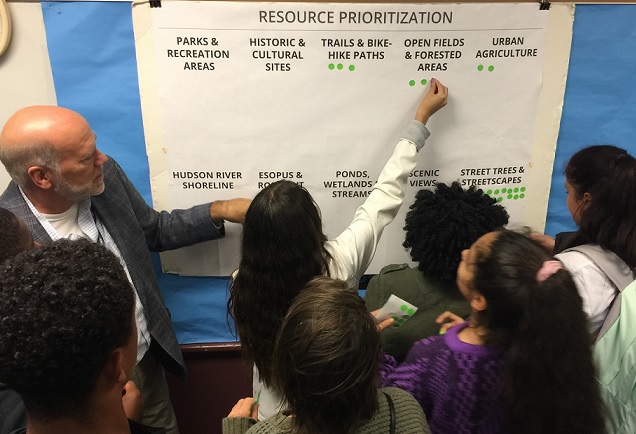
Whether the goal is an open space plan, a conservation overlay zone, or a floodplain protection law, two of the key ingredients for identifying and protecting conservation priorities include: 1) current, accurate data and 2) community input. While the availability of scientific data and mapping tools for local conservation planning has increased exponentially over the last decade, the capacity for meaningful community engagement has not. How can we move away from traditional, one-way information sharing that "checks the boxes" on engagement to genuine community involvement built on shared priorities, vision, and decision-making?
“Patience is a key in this work. It takes persistence through multiple attempts to get people’s attention and build trust, and not all approaches will work in every community.” - from Inclusive Community Engagement Primer, NYS Climate Smart Communities
The Hudson River Estuary Program's Conservation and Land Use Team invites Hudson Valley municipal officials and volunteers, planners, and conservation practitioners to learn together to cultivate conditions for true collaboration and participation at a new program on October 21 and 23. The two-part Inclusive Community Engagement Workshop will include opportunities for self-reflection, group discussions, and presentations from practitioners with diverse experience in municipal and conservation planning, community engagement, and environmental justice.
Guided by The Spectrum of Community Engagement to Ownership framework developed by Rosa González of Facilitating Power, the interactive program will explore:
- impacts of historic land use and marginalization;
- the importance of having diverse voices and groups in community planning;
- case studies and strategies for meaningful engagement; and
- guiding questions for participants to self-assess their engagement activities and begin a path forward to create more inclusive, empowering experiences.
This free workshop includes a virtual session on Wednesday, October 21, 4:30-6:00 pm and an in-person session in Kingston (Ulster County) on Friday, October 23, 1:00-4:30 pm.
Registration and a commitment to attend both sessions are required. Individuals involved in conservation and land-use planning are encouraged to apply. Space is limited and priority will be given to municipal officials and volunteers, including members of conservation advisory councils and planning committees. Participants can receive a certificate for 4.5 hours of municipal training credit.
Registrants will be notified of their acceptance into the workshop by email.
To register for the workshop, click here.
Workshop facilitators:
Dr. Shorna Allred, University of North Carolina at Chapel Hill and Cornell University
Shorna Allred is the Susan R. Wolf Distinguished Professor at the University of North Carolina at Chapel Hill in the Dept. of Geography and Environment, College of Arts and Sciences. She is also an Adjunct Professor at Cornell University in the Center for Conservation Social Sciences, Dept. of Natural Resources and the Environment. A conservation social scientist, Dr. Allred teaches and conducts research in the areas of global sustainability, conservation and land use decision-making, community resilience, and environmental justice. Her main interests center on how social science can facilitate community-based approaches to planning and management while enhancing the resilience and sustainability of communities both locally and abroad.
Dr. Allred earned her Ph.D. from Oregon State University and her B.S. and M.S. degrees from Penn State University. She began her academic career at Purdue University in 2001 and was on the Cornell University faculty from 2007 through 2023. She was also the Associate Director of the Center for Conservation Social Sciences and a member of the Graduate Fields of Natural Resources and Global Development while at Cornell.
Laura Heady, Hudson River Estuary Program and Cornell University
Laura Heady leads the Conservation and Land Use Team at the DEC's Hudson River Estuary Program through a partnership with Cornell University's Dept. of Natural Resources and the Environment. She has more than 20 years of experience working with municipalities, land trusts, scientists, and policy-makers to advance biodiversity conservation in the Hudson estuary watershed. Laura creates and implements innovative programs in conservation planning, outreach, and community engagement; develops new collaborations and convenes partners; and contributes to NYS policy and planning initiatives. Laura also has interests in science communication, habitat connectivity, and strategic planning and is the founding manager of the volunteer Amphibian Migrations & Road Crossings Project and producer of the short documentary, The Nature of Nature: Biodiversity in the Hudson Valley.
Laura earned her M.S. in biology with an emphasis in ecology from Idaho State University, and B.S. in environmental science from Rutgers University. Before joining the Hudson River Estuary Program in 2006, she was the Biodiversity Education Director at Hudsonia, Ltd.
Duane Martinez, Scenic Hudson
Duane Martinez joined Scenic Hudson in 2021, bringing a strategic approach to conservation in cities that is rooted in urban design, natural history, land use planning, and environmental justice. Under his leadership, the River Cities Program advances community-based conservation projects that enhance urban ecosystems and connect people with nature in Kingston, Newburgh, and Poughkeepsie. This work manifests through open space planning, park restoration, and public space activation. Duane’s background includes cohousing development, new farmer education, graphic design, and grassroots activism. He is interested in how participatory design and community science contribute to social and ecological wellbeing in cities.
Duane holds a Bachelor of Environmental Design from the University of Colorado and a M.S. in City and Regional Planning from Pratt Institute.
Gita Nandan, Thread Collective and Pratt Institute
Gita Nandan is an architect, designer, educator, and leader in community resilience planning and design. She is co-founder of Thread Collective, an award-winning multidisciplinary studio focused on creating productive and optimistic environments, and is an adjunct associate professor at Pratt Institute. Ms. Nandan believes in regenerative design as an elastic and supple approach, integrating social, cultural, and economic issues with high design principles to create innovative, net-positive urban environments. Her work is grounded in the belief that the most resilient places are shaped with, rather than simply for, the communities who inhabit them. Through community-engaged design and participatory planning, she brings residents, stakeholders, and local knowledge into the design process, using engagement as a tool to uncover opportunities, build shared ownership, and develop solutions that are both visionary and rooted in place. Her work is at the nexus of where design meets the ecology of place and future-proofing communities, driven by finding creative solutions to complex problems and weaving social justice with the built environment. Projects include the first State of the Bay for the Flushing Waterways, Red Hook Cloudburst Management Plan, and design of ecological floating communities – the On the Water Initiative – for NYC harbors.
She has a Master of Architecture from University of California, Berkeley and a B.A. in Architecture History from University of Michigan, Ann Arbor, and is WEDG and LEED Certified and a licensed practitioner in NY, NJ, and PA.